TikTok Wes (AI)nderson: Fan participation and the auteur in the age of algorithmic reproduction
Cáit Murphy
DOI: https://doi.org/10.82392/6t60-5480
Download the PDF of this article
Abstract
Taking Wes Anderson fan media as a case study, this article reframes auteurism in the context of social media trends and algorithmic reproduction. Anderson’s oeuvre has been subject to mass fan engagement online since the early 2000s. Anderson-based fan media found broader mainstream attention with the viral TikTok Anderson challenge and AI-generated mashups of his style in 2023, prompting scrutiny from film critics for getting Anderson wrong. In this article, I build on Noël Carroll’s (2014) concept of the “creative audience” to understand fans’ impulses to creatively engage with Anderson’s authorship, via the exercising of their imaginations in response to an auteur’s style with the digital and algorithmic tools at their disposal. I firstly critically frame the contributing factors for why Anderson’s films and auteur persona inspire this accumulation of fan media. I then look at key examples from the Internet, including the crowd-sourced Instagram photography project Accidentally Wes Anderson that features fans’ interpretations of real locations through an Andersonian lens. My analysis primarily focuses on the viral Anderson TikTok challenge, which saw participants performing as Andersonian caricatures in micro-short, non-narrative videos. Around the same time, AI-generated parody mashup trailers emerged online, leading to criticism of both AI’s and fans’ inaccurate aping of Anderson’s style. I argue that Anderson’s “creative audience” is helping to co-create his brand name by expressing their cinematic imagination in online fan media, while being informed by the specific affordances of platforms and algorithmic reproduction. Thus, the auteur-director and auteur theory remain productive for understanding fan media in the contemporary context.
Introduction: cinephilia and the creative audience
Wes Anderson has inspired more aesthetic mimicry among social media users than most contemporary auteur film directors have. An “indiewood” director who works alongside Hollywood’s production infrastructure (Kunze, 2014) and with thirteen features as of 2025, Anderson is a well-established auteur. His visual style of symmetrical and highly pre-determined shot compositions, picturesque settings, vintage aesthetics, and deadpan tone has been parodied, remixed, aped, and algorithmically generated. This includes mashup trailers on YouTube, the popular Accidentally Wes Anderson Instagram profile, the viral Wes Anderson TikTok challenge in 2023, and now AI-generated media. It is clear that Anderson’s audience is being actively creative in response to his style. Although discourses on creativity often focus on artists like Anderson, the audience also plays an important role. As Noël Carroll (2014) argues, for the filmmaker to accomplish a desired effect in their work, the “creative audience” must cooperate with the play of their imaginations by mentally simulating and constructing meaning, characters’ points of view, or storyworlds. Carroll (2014: 62) dismisses the idea that cinema audiences are passive and experience cinema at the complete behest of the author’s monolithic imagination. This view challenges long-held ideas in film culture about the “auteur-director” – a figure of artistic and technical authority who can express their personal vision despite cinema’s industrial and collaborative infrastructure.
Despite movements in film studies away from the traditions of auteur analysis (looking towards other creative roles in the industry, for example), the auteur remains pre-eminent in film culture. With the rise of the Internet, the auteur became more prominent as a discourse. Timothy Corrigan’s (1990: 49) theory of the “commerce of auteurism” posits that the paratextual agency of auteurs’ promotional press activities and their star personas could effectively “sell” their films to audiences and critics before they are even watched. This is bolstered by media discourses about auteurs’ personal lives, film festivals, and industry marketing. As Adrian Martin (2004: 95) argues, “this is the era of the auteur as commodity, as brand name.” As Catherine Grant (2008: 102) has noted, with the rise of digital home media like DVD director commentary tracks, cinephiles may now pleasurably “consume” the auteur via such paratextual materials. This is especially apparent through popular auteurs like Anderson, whose paratextual self is frequently articulated in extra-filmic media, as I will explain. Peter Wollen (1972: 168) notably differentiated the director-as-individual from the director-as-discourse (i.e. the difference between Hitchcock as a man/director or “Hitchcock” as the structures named after him). Likewise, there is Anderson (the man/director) and “Anderson.” However, there are also Andersonian fan works, which are the focus of this article.
Cinephilic obsessions with auteur cinema can be classed as “fannish.” In an interview with Edgar Pera (2015: n.pag.), Henry Jenkins notes that the difference between “cinephiles” and “fans” is cultural; fans may wish to “take culture in their own hands” by reshaping and re-enacting their favourite texts, wanting to be “inside” these texts; whereas cinephiles are perceived as more intellectually “distant” from their passion for the cinema medium. However, Jenkins surmises there is little difference between them, taking the example of French New Wave directors who were certainly fans of Hollywood cinema and restaged elements from those films in their own work (Pera, 2015). Fans and fandoms co-construct texts beyond their official or canonical bounds; the media literacy and intertextuality of fan fiction, fake trailers, and mashup videos have been extensively examined (Bonde Korsgaard, 2020; Busse, 2017; Booth, 2012). But cinephiles may also co-construct meaning from auteur films to imagine alternative texts, from fan-made posters to memes. There are dual cinephilic and fannish tendencies in “vidding,” which can be traced to Joseph Cornell’s avant-garde fan-editing techniques in the 1930s (Coppa, 2022: 80; Grant and Random Love, 2019: 16; Pigott, 2013: 71). Cinephiles may also participate in designing fake movie posters that imagine alternative directors in “what if” scenarios (Williams, 2016). As Girish Shambu (2020: 5) has theorised, the traditions of “classical cinephilia” of the twentieth century remain in present-day “new cinephilia”; cinephilia fundamentally relies on discourse amongst audiences, which is now facilitated by social media platforms and other digital tools. Marcel Hartwig (2023) has analysed how David Lynch has been extensively meme-ified in the digital age. Olivia Stowell (2025) has noted how fans collaboratively co-created the “Goncharov” meme on Tumblr and Twitter/X, which imagined a fake Martin Scorsese film. However, the sheer volume and diversity of Anderson-based fan media invites particular critical enquiry.
My aim in this article is to examine Anderson fan media as a case study whereby auteurism can be re-evaluated via the role of fans or the “creative audience,” as well as social media platforms and algorithmic tools, in shaping auteurism in the digital age. This article firstly provides a critical framework informed by scholarship on Anderson’s cinema to consider the reasons behind the prominence and variety of fan media responding to Anderson’s style: his distinctive mise-en-scène; his visibility in ancillary media; and his career coinciding with the rise of social media. My analysis will then briefly trace the history of Internet-based fan media related to Anderson’s work so far, including Accidentally Wes Anderson. By identifying the specific formal and social qualities of these examples, I will show that platform parameters and vernaculars have also played a role in shaping how “Anderson” is proliferated in the digital age. The TikTok challenge, in which users pretended to be Andersonian caricatures in short videos especially brought Anderson-based fan media to mainstream view. I will particularly focus on this viral trend and AI-generated media because they prompted criticism for their lack of cineliteracy. Despite such critiques and in keeping with fan scholarship that sees fan texts as important cultural documents (Busse, 2017; Gray, Sandvoss and Harrington, 2007), my analysis nonetheless sees Anderson fan media as significant creative works that indicate the extent to which cinephilic imagination is shaping auteurism in the digital age.
Carroll’s (2014: 79) concept of the “creative audience” can partly help us to understand why fans are mimicking Anderson’s style. Audiences are engaging in what Carroll (2014: 78) calls “The Thematizing Imagination.” Audiences “[take] notice of the way in which the narrative content and style operate in concert via a presiding concept, theme, or purpose” by thematically organising elements (Carroll, 2014: 79). While Carroll does not mention this, the organising of idiosyncrasies or an overarching style over the course of several films is a key operation of cinephilic auteur criticism. But as Carroll (2014: 80) surmises, while critics expertly exercise their thematising imagination, “most of us find ourselves mobilising it – ordinary readers, listeners, and viewers are no less creative than esteemed critics.” Audiences have organised and co-created an idea of Anderson – his style, tone, themes, and tropes over several decades. Carroll’s theory predated mainstream applications of generative AI amongst film audiences and thus requires new nuance. The “creative audience” examined in this article is not just engaging with Anderson’s films; fans are also copying each other and working within the parameters of platforms and algorithmic tools. I will consider the possibility of an audience’s co-creative imagination in conjunction with algorithms and vast databases of multiple authors’ works. What seems to have developed is a creative audience run amuck with imagination in the social media age, now supported by freely accessible digital and algorithmic tools.
This article will demonstrate that audiences are mobilised and indeed creative in exercising their cinematic imaginations via the auteur. My argument is that while these fan media seem to contradict the individualistic “vision” of an auteur by co-creating Andersonian texts, auteurism remains key to cinephilia in the digital age. As a case study, the mass of (co-)creative responses to Anderson’s cinema from fans shows the simultaneous expansion of digital production for audiences and the remaining pre-eminence of the auteur in film culture. I argue that auteur theory remains productive for understanding fan creativity and algorithmic media, as auteurism informs and is informed by digital culture.
A critical framework: why Wes Anderson?
Before examining examples of Anderson fan media, it is important to provide a critical framework of the possible contributing factors that make Anderson’s cinema so well-suited to the creative imaginations of audiences in the social media age. Firstly, fan mimicry of Anderson’s style tends to emphasise his mise-en-scène. In collaboration with other creatives like cinematographer Robert Yeoman, Anderson has developed a distinctive visual brand over the past two decades. Anderson scholar Mark Browning (2011: ix) has argued that “the only movies Wes Anderson films look like are other Wes Anderson films.” This includes symmetrical compositions, retro décor, pastel colour palettes, vintage costumes, and highly composed character blocking. James MacDowell (2012: 9) argues that Anderson’s style may be characterised by the “static, flat-looking, medium-long or long ‘planimetric’ shot that appears nearly geometrically even, depicting carefully arranged characters, often facing directly forward, who are made to look faintly ridiculous by virtue of a composition’s rigidity.” This visual aspect of Anderson’s filmmaking is often mimicked in online fan media (including the TikTok challenge) as a key signifier of “Anderson,” as I will discuss. The distinctive colour palette or look of films by arthouse and non-Anglophone directors like Aki Kaurismäki, Roy Andersson, or Jacques Tati might be comparable to Anderson’s. But these directors are not as mainstream.[i] Anderson’s consistent flat style and highly pre-determined assembly of objects also reflects Instagram’s visual vernacular. As studied by new media scholar Lev Manovich (2017), well-composed, “flat-lay” photography that privileges symmetry and framing objects shot from above is an established feature of Instagram’s visual culture. Furthermore, the geometrical and flat look of Anderson’s films may also be easy for generative AI systems to mimic algorithmically, although this can’t be determined exactly. Therefore, Anderson’s consistent visual style is perhaps the most fundamental factor, as it determines the basic aesthetic content of online fan works.
Anderson is also highly active in ancillary or paratextual media, which extends his artistic authority beyond his film texts and makes him more visible to audiences. Anderson has developed a distinctive auteur persona that Devin Orgeron (2007) refers to as Anderson’s ‘camera-Crayola’ (derived from the popular crayon brand), which is a more playful alternative to Alexandre Astruc’s (1948) ‘camera-pen’ (a key theory for auteur criticism). Since the publication of Orgeron’s article, Anderson’s online visibility has expanded. Anderson has frequently appeared in recorded interviews, including YouTube-based formats like Konbini Vidéo Club’s walk-through video and Vanity Fair’s explainer video. Anderson’s authorship developed with the refinement of DVD technology and he has participated in behind-the-scenes documentaries and director commentary tracks that extend his paratextual authority (Orgeron, 2007: 41). Anderson’s role as himself in a television commercial he directed for American Express in 2004 plays into popular notions about his auteur persona by being very particular about props, for example. Orgeron (2001: 61) notes the ad’s own mimicry of an “Andersonian mise-en-scène.” At the end of the commercial, Anderson poses with a camera alongside his DOP Yeoman, who significantly remains unnamed in the advert. Anderson’s signature on the back of a bankcard is shown with the tagline “My life. My card” (Fig. 1). This emphasises Anderson’s independence within the industry. In 2024, Anderson also directed and appeared in a commercial for luxury pen company Montblanc to introduce his own custom pen called the Scribbler (Fig. 2). Anderson’s Montblanc product endorsement suits the motif of authorship in his films and his auteur persona. Aside from his personal appearances, Anderson’s style was also parodied by the popular sketch show Saturday Night Live (NBC, 1975-present). Globally located exhibitions and immersive experiences have been dedicated to his work, including at the Cinémathèque in Paris in 2025. This ancillary visibility effectively extends his self beyond his film texts in public consciousness, and thus might encourage fans to engage creatively with his authorship.
[i] Since 1996, all of Anderson’s feature films have been produced or distributed by major Hollywood studios and he has collaborated with major box office stars like Timothée Chalamet and Scarlett Johansson.


Importantly, Anderson’s career, since his debut feature in 1996, has coincided with the rise of the Internet and new cinephilia. Younger audiences (Gen Z and Millennials) who grew up with and may fluently speak the language of Internet platforms may also have come of age with the release of his films. Contemporary younger audiences also happen to be the main trend-setters on apps like TikTok. In relation to this, the dry or ironic tone of Anderson’s cinema may coalesce well with Internet culture. MacDowell (2012: 6) describes Anderson’s films as conveying a “quirky sensibility” and balancing “ironic detachment with sincere engagement.” Indeed, serious or darker issues in Anderson’s films like grief, war, mental illness, and mortality are often treated with absurdity. This tone is easily reproducible on social media, where ironic humour is already distilled into GIFs, memes, and posts on a variety of subjects. Thus, Anderson’s brand seems primed for a young, mobilised audience with access to digital tools.
Anderson: a brief digital history of fan co-creation
While it is not possible to account for all Anderson-centric fan media, there are some significant examples. Since the early 2000s, fans have used Internet-based resources to express themselves through the lens of Anderson’s style. Orgeron (2007: 64) noted an online campaign by fans to make the Adidas sneakers worn by the characters in Anderson’s The Life Aquatic with Steve Zissou (2004) a reality. Adidas didn’t manufacture the limited edition sneakers until 2017, while fans had designed their own DIY versions (Woolf, 2017). Rather than cosplaying as Anderson’s characters (as other fandoms do with their favourite media), fans sought a niche fashion item associated with Anderson’s brand. Fans could express their cinephilic taste through the stylistic flourishes of Anderson’s vision. This early example shows a fannish desire to extend Anderson’s authorship beyond his films.
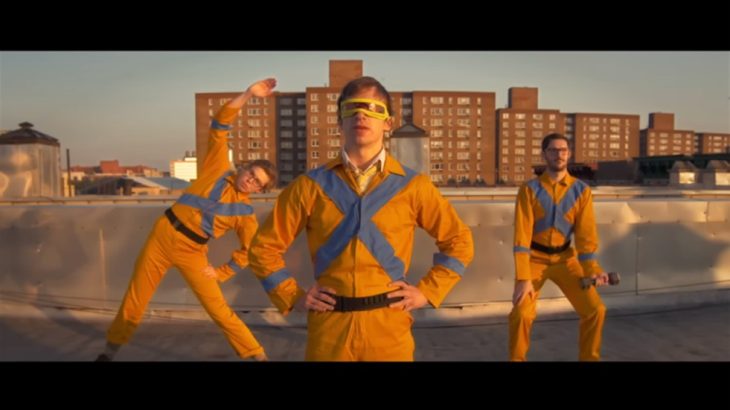
One significant aesthetic precursor to the more recent TikTok trend and AI-generated examples is the YouTube mashup parody “What if Wes Anderson Directed X-Men?” (2015), with over 4.4m views (Fig. 3). Edited in the style of a trailer, the video is nearly 4 minutes long and presents itself as Anderson’s adaptation of the Stan Lee comic series. Although the trailer satirises tropes in Anderson’s work such as symmetrical compositions and vintage costuming, the creators are clearly admirers. Considerable production value has gone into this short video. The creators used home green-screens and a miniature cross-section of a dollhouse for special effects scenes. The team also filmed outside of the real Tenenbaum house from The Royal Tenenbaums (2001) in New York City, pointing to a desire to get closer to Anderson’s own production choices. As Mathias Bonde Korsgaard (2020: 107) has analysed, fake trailers can be described as “imaginary paratexts” that show the “audiovisual literacy” of fans. Similar aesthetic mashups on YouTube include “Wes Anderson’s The Shining” (2015) and “The Sopranos directed by Wes Anderson” (2022), which edit pre-existing media to look Andersonian. Aesthetic mashups would later be afforded automatically by generative AI systems.

The collaborative potential of Anderson-based fan media was realised on a global scale with the Accidentally Wes Anderson (@accidentallywesanderson) Instagram profile, launched in 2017 by Wally Koval. The profile is a crowd-sourced gallery of mostly still images showing globally located colourful and idyllic public spaces, buildings, and objects that are Andersonian (Fig. 4). Originating with Koval’s travel photography, the project developed through his use of the Instagram hashtag “#accidentallywesanderson,” which was then used by others (BBC, 2020). The account now has 1.9m followers and over 2k posts. The Instagram profile has spawned book publications and exhibitions. Rather than being the products of an individual author, AWA’s collection is co-created by different photographers. And while Anderson’s films are composed of elaborate custom-built sets that are meticulously decorated for the purposes of a film, the locations in this book are pre-existing structures that happen to be Andersonian. This contrast brings to mind the meaning of mise-en-scène (literally put in place) as a system of artistic decisions. The project shows locations that have not been arranged by any film director. And yet, the overwhelming authorial voice being enunciated is Anderson’s. Interestingly, Anderson provides the foreword to the photography book, explaining that he has never visited these beautiful sites, but surmises: “I am still confused what it means to be deliberately me, if that is even what I am” (Koval, 2020: xi). Here, Anderson questions his own agency and points to the main paradox of a project that celebrates his unique vision, while supposing that his aesthetic is not entirely his.[i] AWA has even participated in promoting Anderson’s new releases like Asteroid City, thus showing the mutual benefit of such digital collaborations. While the AWA project exists without Anderson’s oversight, his authorial authority is still important.
[i] It is possible that Anderson receives a percentage of the book’s profits, but this is not public knowledge.

As a demonstration of the strong links between Anderson’s style and social media cultures, the aesthetics of AWA reflect Instagram’s aesthetic vernacular. Anderson’s films visually align with Instagram’s aesthetic trends in photography that privilege symmetry, centrally-placed objects, and flat-looking compositions – what Manovich (2017) calls “designed” photography on the platform. Instagram’s iconic square-shaped blocks of photos on user profiles affirm the appearance of symmetry and geometrical compositions. Thus, a filmmaker like Anderson whose mise-en-scène can easily fit into these visual parameters is ideal for the platform; Anderson’s style is recognisable even in square grids. AWA effectively speaks the language of social media aesthetics and marketing. Koval’s entrepreneurial approach is clear in the book’s blurb: “Authorised by Wes Anderson himself, and appealing to the millions who love his films, this book is also for fans of Cabin Porn and Van Life – and avid travellers and aspiring adventurers of all kinds.” The aesthetics of “van life” and travel lifestyle accounts include vloggers and brand-sponsored influencers. Thus, Anderson’s aesthetic may appeal to a tourist sensibility, beyond merely fans of his films, broadening the potential market for this book. The book conforms to the imagery of travel books that emphasise well-composed images of pretty mountains, unusual landmarks, and hidden gems. The homogenising brand of these sites when assembled as a publication is their perceived Andersonian aesthetic despite his complete absence in their construction. Thus, through a subjective Andersonian lens, real spaces can be re-interpreted by fans as co-created spaces regardless of their artistic origins.
Anderson fan media may demonstrate “medial projection,” as theorised by Jørgen Bruhn (2016: 51), which may be understood as seeing the world through the framework of media. Bruhn’s more specific term “cinematic projection” refers to the phenomenon of seeing the world as if it were a film. While Bruhn is referring to literary characters who see cinematically, this phenomenon can also be observed in other media, social media practices, and even in everyday conversations. Indeed, articles advising readers on how to make their home look like an Anderson film (Dray, 2023) or how to dress like an Anderson character (Zucker, 2023) encourage cinematic projection. Cinematic projection occurs explicitly when social media users apply augmented reality filters to real spaces. Anderson-labelled AR filters were widely available in search results on Instagram Stories, with over 80 examples in autumn of 2024.[i] Some AR filters applied a warm colour or pastel tint to an environment and/or included overlaid text that altered spaces, as I tried out below (Fig. 5). The world becomes an Andersonian mise-en-scène for the creative audience using these digital tools.
[i] Many of these Anderson filters on Instagram Stories are now unavailable since Meta removed Spark AR third-party filters in January 2025.


The Anderson TikTok challenge
With this background of Internet-based fan media in mind, the TikTok challenge stands out aesthetically and culturally as a brief online phenomenon lasting from about April to May 2023. That year, Asteroid City (2023) was released in cinemas and Anderson’s shorts adapted from Roald Dahl stories were released on Netflix, thus prolonging Anderson’s visibility amongst audiences. According to Paul Glynn (2023), the challenge started with 26-year-old TikTok fashion influencer Ava Williams (@avawillyums), who recorded her train journey in New York with her smartphone (Fig. 7). Opening on a static shot of an empty train (with the title, “You better not be acting like you’re in a Wes Anderson film when I get there”), Williams remains still and silent, positioned in centre-frame in medium to wide shots to mimic Anderson’s style. The post is further captioned: “With a good imagination, everything is symmetrical. Let a girl day dream [sic]! #wesanderson.” Williams explained that she was inspired to make the video after watching Anderson’s The French Dispatch (2021) the night before (Glynn, 2023). The video is accompanied by Alexandre Desplat’s “Obituary” from the film. Since April 2023, Williams’s video has amassed over 2.3 million likes on TikTok, making it one of the most popular examples of Anderson fan media online.

The subsequent online proliferation of the trend across platforms as a meme or challenge relied on community participation in expressing creative playfulness. Williams’s original text caption and style were copied by other participants, although not all videos followed the exact same format. As per Limor Shifman’s (2013) definition, memes are broadly defined as units of cultural distribution that are easily mimicked in content, form, and stance. According to Diana Zulli and David James Zulli (2020: 1873), mimesis is the basis of sociality on TikTok, extending Shifman’s concept of the Internet meme to the level of platform infrastructure. And as Tom Divon and Laura Cervi (2023: 4) add, TikTok challenges are essentially memes that are “reproduced by imitation and spread rapidly, with creative variations.” The Anderson challenge indeed encouraged mimesis, with some variations. Participants recorded and edited their own short videos, thus requiring some planning, blocking, and editing decisions. Demonstration videos emerged on TikTok explaining how to choose filters or cut video to the beat of music in editing, which is an important component of film language. This shows how the trend could be collaborative, with some taking form and quality more seriously, as the TikTok comments demonstrate below (Fig. 8). Although mostly comprised of still images, the popular @accidentallywesanderson Instagram profile may have also inspired the aesthetics of the challenge. Indeed, many participants selected picturesque locations for their videos, much like Koval’s crowdsourced project. Available AR filters uploaded by different users on Instagram Stories, for example, may have been used by participants. Thus, while Anderson’s style was an important influence on the trend, the creative audience also inspired each other via cross-platform affordances of form and sociality.

The formal aspects of this trend were partly reflective of the platform’s affordances and partly determined by individuals’ different creative approaches. Unlike the X-Men mash-up trailer from 2015 (shot in a more cinematic format), the trend was filmed and predominantly watched on vertically oriented smartphone screens. The TikTok videos are also significantly shorter than their YouTube predecessor, which corresponds with TikTok’s endless scrolling temporality. Videos were “frontal” and highly aware of the spectator, which Elizabeth Mears and Masha Shpolberg (2021: 3) have theorised as typical of TikTok’s aesthetic vernacular. Suitably, front-facing blocking of characters in centre-frame in Anderson’s films happens to align with this “frontal” style. While working within the existing conventions on the platform, creators also expressed their own unique approaches. For example, in his popular video, Kyle Rothwell (@kyle_rothwell) is dressed as an auteur filmmaker archetype, wielding a Minolta Super 8 camera and wearing an army-style jacket, round sunglasses, and a red beret (Fig. 9). Rothwell’s persona might be partly inspired by Max Fisher (Jason Schwartzman) in Anderson’s Rushmore (1998). Valeria Shashenok’s (@valerisssh) video, “If Wes Anderson made a movie in Ukraine,” was posted on TikTok in April 2023, over a year since the Russian invasion in February 2022 (Fig. 11). Unlike most videos of war that permeate social media, this video is augmented with a pastel-pink filter and features pink lettering and is accompanied by Desplat’s “Obituary” track. The juxtaposition between destroyed apartments and the twee aesthetics of Anderson’s brand is startling. Underlying this is the fact that Shashenok could not control her environment as Anderson does with his production mise-en-scène. But the tone of Shashenok’s video is partly faithful to the style of Anderson’s films: a serious issue like war is treated with a degree of detachment. Here, a participant is projecting an idea of “Anderson” onto this real landscape.


While the trend may have originated as a non-commercial expression of imagination, its virality quickly presented a useful promotional scenario. The social media accounts of well-known brands and organisations like Penguin Books copied the trend, as well as celebrities and politicians, demonstrating Anderson’s commercial, brand-name viability. The trend was timed especially well for the release of Anderson’s film Asteroid City, which was to be released that summer. The actors who starred in Asteroid City were prompted by Universal (the film’s distributor) to participate in their own version at the Cannes premiere press junket in May (Fig. 11). The video, recorded on a smartphone in portrait mode, was uploaded to Universal Pictures’ official TikTok and Instagram accounts. The actors, including leads Scarlett Johansson and Schwartzman, are seen sitting or standing centre-frame in static shots and making small deliberate gestures in silence. Like Williams’s video from the previous month, the video uses the track “Obituary.” The video barely alludes to details from Asteroid City (for example, Schwartzman’s use of a camera references his photojournalist character). With deadpan facial expressions and a lack of costuming, the actors are not so much playing their characters from Asteroid City as they are imitating the trend that was co-created by fans. Anderson is potentially still informing their gestures based on their previous official performances for him. Meanwhile, Anderson has no visible role in this video. This shows how the collaborative imaginations of audiences can benefit the industry as a marketing tool, while the auteur remains uninvolved.

As the trend received media attention, some critics lambasted fans’ failed attempts to mimic Anderson’s work. Criticism focused on fans’ lack of knowledge about cinematic techniques and production value. For critics, this was a matter of TikTok users jumping the bandwagon versus genuine cineliteracy and cinephilia. For IndieWire, Christian Blauvelt (2023) argued that close reading of a filmmaker’s style “is essential for film literacy. But to be film literate, it’s important to be ‘well read’, so to speak.” Blauvelt commented on the TikTok challenge:
Aside from the offensiveness of fans thinking they know a director’s style better than the director (or thinking it can be so easily boiled down to AI-ready bullet points of an essence), it’s so indicative of the moment, in which poor copies of great work are thought to be entertaining of themselves.
Blauvelt’s comment implies that fans were merely jumping on the bandwagon of a viral trend, insulting the artistic figure they ostensibly admire. This comment certainly speaks to broader current discourses on endless film remakes, ephemeral trend culture, and anxiety over AI’s threats to labour and creativity. Indeed, these TikTok videos generally did not replicate Anderson’s techniques or narrative elements. Some participants may not have even seen Anderson’s films, which certainly does not prevent participation. The videos were more like brief sketches or impressions with caricatures rather than mimicry of his film narratives, per se. For example, Williams’s, Rothwell’s, and Shashenok’s videos only last between 22 and 24 seconds. Planning, writing, filming, and editing the fake X-Men trailer required considerable effort, production cost, and time. But, comparatively, these TikTok videos are shorter, simpler, and employ basic in-built editing tools through the app. Participants also largely avoided recording original sound by using text captions and Desplat’s “Obituary” track as a non-diegetic score. The element being mimicked in these TikTok videos is Anderson’s visual style and tone and not the finer plot-related details of his work. Even signature aspects of Anderson’s films, like compilation soundtracks of older songs, voice-over narration, framing devices, or allusions to older films were not widely mimicked. This may diminish Anderson’s artistry to visual style, while ignoring other aspects like screenwriting. Thus, these videos do not really pose a threat to Anderson’s authorship. These videos partly reflect a paratextual idea of “Anderson” that has developed online and alongside his film texts. And importantly, fans were inspired by each other, which is typical of mimetic social media trends.
Anderson and generative AI
The mainstreaming of generative AI systems has introduced an algorithmic component to aesthetic mimicry of Anderson’s style. Although generative AI imagery repeats long-existing features of online fan mimicry of Anderson’s work – such as symmetrical compositions and vintage styles – the machine-based identity of AI-generated media brings a new dimension that challenges Anderson’s authorial authority more sharply. While the styles of other auteurs can be mimicked using generative AI, reproductions of Anderson’s style have been particularly noteworthy as a popular online practice. From messy text-to-image mashups using DALL-E Mini/Craiyon in 2022, to more photorealistic images and videos using Midjourney and Stable Diffusion, users have experimented in generating media that resemble Anderson’s mise-en-scène (Fig. 12). For example, the Craiyon-generated “McDonald’s Wes Anderson” output – although crude and misshapen – shows the system’s ability to tie Anderson’s style with pastel colours and centred compositions as signifiers of “Anderson” in its dataset and reproduce this algorithmically (Fig. 13) (see: O’Meara and Murphy, 2023: 1078-1079). As AI systems trawl tagged images from Internet databases and algorithmically reproduce an aesthetic cocktail of these images in their outputs, it is likely that tagged still images of Anderson’s films are widely available online (like Google Images and Pinterest) and in these systems’ datasets. Aesthetic mimicry by fans, such as AWA imagery, may contribute to the well of data, thus potentially recycling fan media to create more fan media. As of autumn 2025, Googling “Wes Anderson style” will prompt top search results that include real stills from Anderson’s films, AWA imagery, as well as some AI-generated imagery from Anderson films that do not exist. AI generators may be trained on real still images from his films and fake still images, thus creating imagery that is far removed from Anderson’s direct authorship. In conjunction with algorithms, the creative audience is therefore directly impacting what “Anderson” means in search engines and databases.

By coincidence, AI mimicry of Anderson’s style became a viral phenomenon during the height of the TikTok challenge in April 2023 and prompted critical discourse. Uploaded to YouTube, the AI-generated one-minute fake mashup trailer by Curious Refuge for Anderson’s version of Star Wars has received over 3 million views. In the video, familiar objects from Star Wars such as lightsabres and spacecraft are aesthetically altered to look more vintage and vibrant, while Star Wars characters are played by stars from Anderson’s films, such as Johansson as Princess Leia (Fig. 13). The trailer was essentially a viral advertisement for Curious Refuge, which is a start-up company that specialises in training filmmaking professionals in using generative AI. More Anderson AI-generated mashups by Curious Refuge and other YouTube accounts soon followed, seemingly capitalising on the popularity of the Star Wars version. This further demonstrates Anderson’s broad commercial viability. Several comments from Anderson fans underneath the YouTube video express how they wish the trailer were real, showing the appeal of mashups as imaginary paratexts.

Seemingly as a reflection of the AI system’s limitations, the characters in the trailer are silent and move rigidly in static compositions, with uncanny facial distortions. But stiffness, small gestures, and silence were also demonstrated by participants in the TikTok challenge, perpetuating the idea that Anderson’s films are deadpan. Stuart Heritage (2023) criticised the similarities between this trailer and the TikTok challenge:
It’s enough to make you want to crawl inside your computer, grab AI by the lapels and shout “STOP DOING WES ANDERSON WRONG.” To be fair, humans are just as bad […] The only thing they do is spoof other Wes Anderson spoofs.
Indeed, the TikTok challenge and this AI trailer, alike, may have been inspired by previous iterations of Anderson fan media, including Accidentally Wes Anderson. This accumulation of fan media, as I mentioned, may then be recycled in Anderson AI outputs. The “thematising imagination” that audiences exercise in response to cinema, to invoke Carroll, can be recycled algorithmically in the form of a few identifiable tropes. On the one hand, the long-held idea of the auteur is being re-interpreted by lending generative AI the paintbrush, so to speak. But AI generation also requires the human user to make decisions by inserting prompts. Therefore, while the quality of these AI-generated media is open to scrutiny, fans of Anderson’s work may nonetheless exercise their “thematising imagination” via these tools.
These examples of AI-generated media demonstrate that while auteurs can inspire the imaginations of audiences with their distinctive styles and paratextual personas, they do not have control over their creative audience. In 2023, Anderson commented on the TikTok challenge and AI mimicry: “If somebody sends me something like that, I’ll immediately erase it. […] I don’t want to see too much of someone else thinking about what I try to be because, God knows, I could then start doing it” (Blauvelt, 2023). Similarly responding to AI mimicry of his work, director Tim Burton has said, “It’s like a robot taking your humanity, your soul” (Los Angeles Times, 2023). A more recent example of AI mimicry of a film style going viral was the Studio Ghibli trend, which saw the animation style of Hayao Miyazaki being widely generated after a ChatGPT update. The meme was even used for propaganda by the Trump White House, forsaking Miyazaki’s own leftist politics and personal criticism of AI (Klee, 2025). Filmmakers may not want to be creatively contaminated by these works that bear their name. Although viral trends that copy an auteur’s style indicate the broad popularity of and perhaps admiration for that auteur, they ultimately contradict the auteur’s artistic authority. A tension arises from the participatory value of popular online trends enjoyed by the “creative audience” and an auteur’s personal artistic vision.
Conclusion
By examining the case study of Wes Anderson fan media, this article has critically resituated auteurism in the contemporary context of social media trends and algorithmic culture. This article has shown that social media and algorithmic tools are now firmly intersecting with auteurism. Auteur theory remains productive for understanding fan creativity and algorithmic culture. It is not surprising that a highly motivated creative audience would take culture in their own hands. As ordinary people gain access to mobile cameras, digital editing, and instant distribution sites, they have more opportunities to potentially talk back to their favourite filmmakers. Carroll’s concept of the “creative audience” finds continued resonance in the present context, as social media users repeatedly demonstrate their awareness of tropes, themes, and style in cinema using novel digital platforms and tools to express this knowledge. Platforms like TikTok socially, algorithmically, and formally encourage mimesis and co-creation. Despite criticisms of fans’ lack of cineliteracy, social media users’ imaginations in response to cinema are the signs of an audience that still watches, imagines, and creates. Fan trends like the Anderson TikTok challenge can be easily adopted by the industry to promote auteur films. Although social media fan trends and generative AI might insult an auteur’s authority by diminishing their artistry to a few obvious tropes, the auteur’s authoritative position is ultimately not under threat. As Anderson released The Phoenician Scheme in 2025, fan media certainly haven’t hindered his creativity. In a sense, “Anderson” is everywhere and can be co-created by anyone, but the real Anderson retains his pre-eminent author status.
The recent emergence of generative AI interpretations of auteur cinema has yet to be extensively theorised in film scholarship. As ordinary social media users access generative AI tools through capitalist market forces, the ethical and economic dimensions of labour, copyright, and authorship are potentially obfuscated. What must be considered is ownership over style: who owns Anderson’s style? Underlying this question is the existing problem of auteurism within the film industry, namely the often disregarded labour of collaborative film productions. It is important to consider the labour required to make an Anderson film in the first place. These unseen artists – carpenters, costume designers, prop-makers, set decorators and so on – go unnamed when prompting Anderson’s style. Their work, too, is potentially recycled in AI outputs. Thus, there are multiple and often invisible layers to the co-creative roles in algorithmic reproduction. In the age of algorithmic reproduction, the co-creative playfulness with which audiences approach auteurism with new digital tools warrants further analysis.
About the author
Cáit Murphy is an early career researcher and lecturer in the Film Department, Trinity College Dublin. Her PhD research was funded by the Provost’s PhD Project Award. Her thesis investigated the re-imagining of Alexandre Astruc’s theory of the caméra-stylo (1948) in the social media era. She has authored and co-authored articles on generative AI and surrealism with Convergence, on Claire Denis’s creative uses of Instagram with NECSUS, and on desktop documentary with Frames Cinema Journal.
Email: cmurph59@tcd.ie
ORCID: https://orcid.org/0000-0002-0698-3584
References
Astruc, A. (1948) La naissance d’une nouvelle avant-garde: La caméra-stylo. L’Écran
français, 30 March (144).
BBC. (2020) Accidentally Wes Anderson: When real life meets fantasy. 25 November.
Available at: https://www.bbc.com/culture/article/20201123-accidentally-wes-anderson-when-real-life-meets-film-fantasy.
Blauvelt, C. (2023) Wes Anderson Is Right to “Immediately Erase” Videos He Receives
Reimagining Movies in His Style. IndieWire, 19 June. Available at: https://www.indiewire.com/news/breaking-news/wes-anderson-videos-reimagining-movies-in-his-style-1234876288/.
Bonde Korsgaard, M. (2020) Fake trailers as imaginary paratexts. MedieKultur: Journal of
Media and Communication Research 36(68): 107-125. DOI:
https://doi.org/10.7146/mediekultur.v36i68.118431.
Booth, P.J. (2012) Mashup as temporal amalgam: Time, taste, and textuality. Transformative
Works and Cultures (9). DOI: https://doi.org/10.3983/twc.2012.0297.
Browning, M. (2011) Wes Anderson: Why His Movies Matter. London: Bloomsbury.
Bruhn, J. (2016) The Intermediality of Narrative Literature: Medialities Matter. London:
Palgrave Macmillan.
Busse, K. (2017) Framing Fan Fiction: Literary and Social Practices in Fan Fiction
Communities. Iowa City: University of Iowa Press.
Carroll, N. (2014) The Creative Audience: Some Ways in which Readers, Viewers, and/or
Listeners Use Their Imaginations to Engage Fictional Artworks. In: Elliot Samuel Paul and Scott Barry Kaufman (eds). The Philosophy of Creativity: New Essays. Oxford: Oxford Academic, 62-81.
Corrigan, T. (1990) The Commerce of Auteurism: A Voice without Authority. New German
Critique (49): 43-57. DOI: https://doi.org/10.2307/488373.
Dray, K. (2023) How to transform your home into an ‘accidentally Wes Anderson’ movie.
Ideal Home, 05 May. Available at: https://www.idealhome.co.uk/living-room/living-room-decor/wes-anderson-home-decor-ideas.
Glynn, P. (2023) Wes Anderson: How TikTokers are giving their lives the US director’s film
treatment. BBC, 26 April. Available at: https://www.bbc.com/news/entertainment-arts-65396444.
Grant, C. (2008) Auteur Machines? Auteurism and the DVD. In: James Bennett and Tom
Brown (eds) Film and Television After DVD. London: Routledge, 101-115.
Grant, C., and Random Love, K. (eds) (2019) Fandom as Methodology: A Sourcebook for
Artists and Writers. London: Goldsmiths Press.
Gray, J., Sandvoss, C., and Harrington C.L. (eds) (2007) Fandom: Identities and Communities in a Mediated World. New York: New York University Press.
Hartwig, M. (2023) Room to Meme: “David Lynch” as Problematic and Self-Evident
Aesthetic Object in Digital Memes. In: Marcel Hartwig, Peter Niedermüller and Andreas Rauscher (eds). Networked David Lynch: Critical Perspectives on Cinematic Transmediality. Edinburgh: Edinburgh University Press, 189-206.
Heritage, S. (2023) Please stop using AI to make Wes Anderson parodies. The Guardian, 11
May. Available at: https://www.theguardian.com/film/2023/may/11/wes-anderson-parodies-ai.
Klee, M. (2025) Miyazaki Fans Sure Are Pissed About ChatGPT’s Studio Ghibli AI Slop.
Rolling Stone, 28 March. Available at: https://www.rollingstone.com/culture/culture-news/miyazaki-chatgpt-ai-slop-1235305906/.
Koval, W. (2020) Accidentally Wes Anderson. London: Trapeze.
Kunze, P.C. (ed.) (2014) The Films of Wes Anderson: Critical Essays on an Indiewood Icon.
New York City, NY: Palgrave.
Manovich, L. (2017) Instagram and Contemporary Image. Available at:
https://manovich.net/index.php/projects/instagram-and-contemporary-image.
MacDowell, J. (2012) Wes Anderson, tone and the quirky sensibility. New Review of Film
and Television Studies 10(1): 6-27. DOI: https://doi.org/10.1080/17400309.2012.628227.
Martin, A. (2004) Possessory Credit. Framework, 45(1): 95-99.
Mears, E. and Shpolberg, M. (2021) New Age, New Media: TikTok as Ritual Practice. Media
Fields Journal (16): 1-8. Available at: https://mediafieldsjournal.org/new-age-new-media/2021/4/18/new-age-new-media-tiktok-as-ritual-practice.html.
O’Meara, J. and Murphy, C. (2023) Aberrant AI creations: co-creating surrealist body horror
using the DALL-E Mini text-to-image generator. Convergence 29(4): 1070-1096. DOI: https://doi.org/10.1177/13548565231185865.
Orgeron, D. (2007) La Camera-Crayola: Authorship Comes of Age in the Cinema of Wes
Anderson. Cinema Journal 46(2): 40-65. DOI: https://www.jstor.org/stable/4137181.
Pera, E. (2015) Fans & Cinephiles (Henry Jenkins Interview). 02 December. Available at:
https://edgarpera.org/2015/12/02/fans-cinephiles-henry-jenkins-interview/.
Pigott, M. (2013) Joseph Cornell Versus Cinema. London: Bloomsbury.
Shambu, G. (2020) The New Cinephilia. Montreal: Caboose.
Shifman, L. (2013) Memes in a digital world: reconciling with a conceptual troublemaker.
Journal of Computer-Mediated Communication 18(3): 362-377. DOI:10.1111/jcc4.12013.
Stowell, O. (2025) Goncharov’s Auteurish Aesthetics. In Media Res, 03 February. Available
at: https://mediacommons.org/imr/content/goncharov’s-auteurish-aesthetics.
Williams, K. (2016) Directed By…: Anticipatory Nostalgia in ‘What If’ Posters. In Media
Res, 13 April. Available at: https://mediacommons.org/imr/2016/04/05/directed-anticipatory-nostalgia-what-if-posters.
Wollen, P. (1972) Signs and Meaning in the Cinema. London: Secker & Warburg.
Woolf, J. (2017) Adidas Made Steve Zissou Sneakers and Actually Sold Them to the Masses.
GQ, 28 June. Available at: https://www.gq.com/story/adidas-senakers-steve-zissou-life-aquatic.
Zucker, C. (2023) Dress Like a Wes Anderson Movie for the Ultimate Twee Girl Summer.
Byrdie, 08 July. Available at: https://www.byrdie.com/wes-anderson-style-trend-7555869.
Zulli, D. and Zulli, D.J. (2020) Extending the Internet meme: Conceptualising technological
mimesis and imitation publics on the TikTok platform. New Media & Society 24(8): 1872-1890. DOI:10.1177/1461444820983603.
Filmography
Asteroid City (2023) Directed by Wes Anderson. USA: Universal Pictures.
The French Dispatch (2021) Directed byWes Anderson. USA: Searchlight Pictures.
The Life Aquatic with Steve Zissou (2004) Directed by Wes Anderson. USA: Buena Vista Pictures Distribution.
The Phoenician Scheme (2025) Directed by Wes Anderson. USA: Universal Pictures.
The Royal Tenenbaums (2001) Directed by Wes Anderson. USA: Buena Vista Pictures Distribution.
Rushmore (1998) Directed by Wes Anderson. USA: Buena Vista Pictures Distribution.